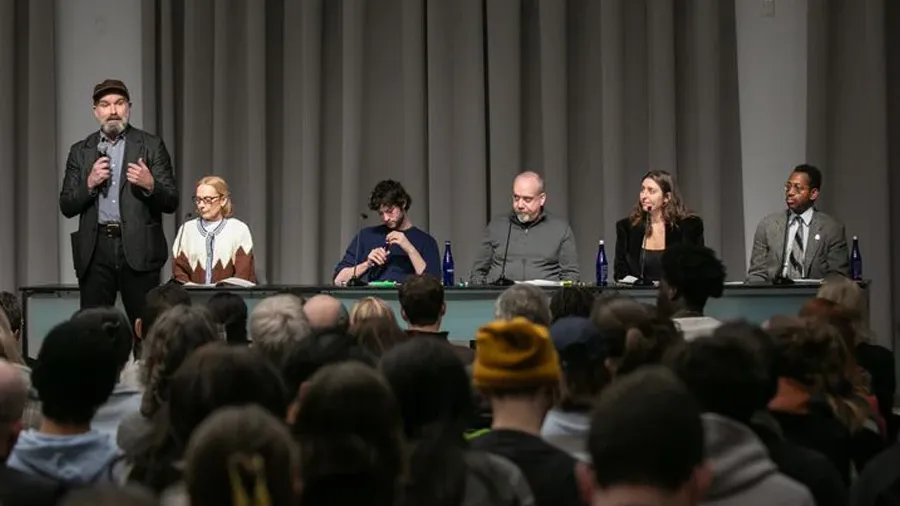
Theater of War Productions returned to Columbia on Nov. 17 with a dramatic take on a piece of contemporary journalism: Hua Hsu’s New Yorker article “What Happens After A.I. Destroys College Writing?” About 250 people turned out for the live reading, held at the Jamail Lecture Hall at the Journalism School.
The show featured performances by Paul Giamatti (Billions), Dominic Sessa (The Holdovers), Amy Ryan (The Office), Eric Berryman (Atlanta) and Marjolaine Goldsmith (Dress). It was co-presented by the Undergraduate Community Initiative, the Center for the Core Curriculum, the Journalism School, Arts & Sciences and CJS2030: The Initiative on AI, with special thanks to The New Yorker.
The reading was a departure from Theater of War’s prior Columbia performances, which drew on ancient texts such as The Iliad and The Trojan Women, as well as Shakespeare’s King Lear. But afterward, the group’s trademark town hall-style discussion provided a through line, as audience members talked about the use of artificial intelligence both inside and outside the classroom, and its implications for the future of higher education. By the end, attendees had shared a range of perspectives and personal experiences with AI, both cautionary and how it’s been useful.
“My hope going into the event was that it would provide Columbia an occasion to talk as a community about our evolving experiences and norms around AI. It did exactly that,” said Jonathon S. Kahn GSAS’03, senior associate dean of community and culture. “Forums like this are crucial. The audience was deeply engaged. And instead of a top-down, setting-policy conversation, this event was truly a grassroots, community-experience discussion.”